Showing posts with label London - Ontario. Show all posts

Wednesday, 5 August 2026

Jeff Culbert's "Theatre Boom Town"


Jeff Culbert (the great-great-grandson of John Culbert and Mary Ward) is the author of the newly published Theatre Boom Town: London, Ontario at the Turn of the Millennium (2002-2015).


In this collection, Jeff has compiled his writings about London's vibrant theatre scene from the period 2002-2015.

Jeff, who grew up in Lucan, Ontario and now makes his home in London, is an accomplished theatre director, playwright, actor, musician, and more. 

You can purchase a copy of Theatre Boom Town for $19.99 + tax through Volumes Publishing. Click here to place your order. Delivery to anywhere in Canada is $10.00. 

Click here to watch an interview with Jeff on CBC Radio's London Morning.


JEFF CULBERT'S FAMILY TREE:
Ancestors:
John Culbert & Mary Ward (great-great-grandparents)
Richard Culbert & Jane Eleanor Fairhall (great-grandparents)
Myron Manford Culbert & Effie Pearl Taylor (grandparents)
Merton Manford Culbert & V. Muriel Hardy (parents)

Monday, 2 August 2021

X-ray Vision: The Fluoroscope Fad

 In a previous post, we saw Mary (Patrick) Culbert (wife of Milward Taylor "Mel" Culbert) walking past the Rowland Hill's Shoe Store in London, Ontario in 1945 with her three-year-old son, Terrence Patrick "Terry" Culbert and her baby daughter, Dana Elizabeth Culbert.

Mary (Patrick) Culbert with son Terry Culbert and daughter, Dana Culbert (in pram) walking by Rowland Hill's Shoe Store on Dundas Street in London, Ontario, 1945.

Terry was probably hoping to drag his mother into the shoe store. Why? So that he could x-ray his feet!

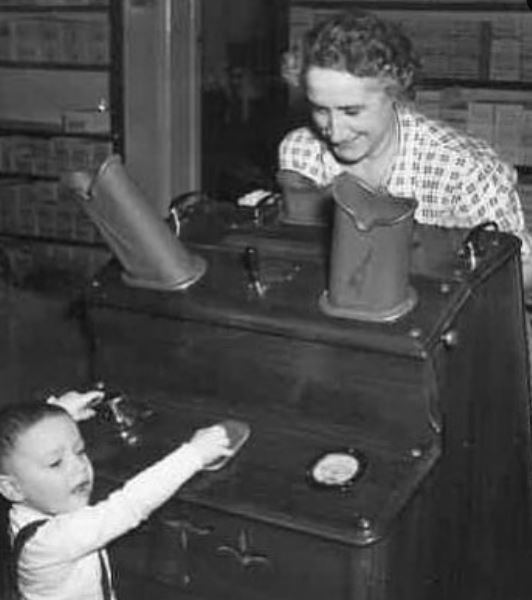
Inside Rowland Hill's Shoe Store was a device known as a fluoroscope or a pedoscope.

Advertisement for Rowland Hill's Shoe Store's X-ray shoe fitting equipment, i.e. fluoroscope. Source: London Free Press, 31 October 1935.
Terry Culbert says, “It was a thrill to use that machine! You could look through the viewer and see the bones of your feet!” His sister, Dana (Culbert) Garrett remembers that “it was the highlight of every shopping trip!

Fluoroscopes began popping up in shoe stores in Canada and the United States during the 1920s. Purported to be a shoe-fitting aid, their popularity lasted for decades. 

X-Ray Shoes sign at a store in St. Petersburg, Florida, 1930s. The bench also says X-Ray Shoes.

Fluoroscope frenzy, 1920s.

As a child in the 1960s, I shared Terry and Dana’s excitement at using that marvel of a machine. I couldn’t wait to run into Rowland Hill’s Shoe Store and slide my feet into the fluoroscope.

1940s Fluoroscope demonstration.

In 1999, Time magazine described the fluoroscope as one of “The Worst Ideas of the Century” but to children, it was a miracle machine.

The fluoroscope stood at about 4 ½ feet high. An x-ray device was concealed within the fluoroscope.

How did it work? First, you tried on a new pair of shoes. Then, you slid your feet into the two slots at the base of the fluoroscope. Next, you peered into one of three viewers at the top of the fluoroscope. You then set a timer, and looked at the image of your feet on a screen. You could clearly see the bones of your feet, glowing green!

If you wiggled your toes, you could see your bones move. It was like watching a dancing skeleton.

As mentioned, the fluoroscope had three viewers at the top. Up to three different people could look at the bones of your feet at the same time. For example, a child could observe the bones of their feet through one viewer while their mother and the salesperson looked through the other two viewers.

The salesperson claimed to be able to see if the shoes fit you properly by looking through the viewer at your bones. However, the proper fit of a shoe is based on the soft tissues of the foot, not the bones. Undoubtedly, the fluoroscope was more of a sales gimmick than a tool.

A section from a shoe salesperson’s fitting card.

According to an article in the University of Chicago’s The History of Social Science, “the shoe-fitting fluoroscope was nothing more or less than an elaborate form of advertising designed to sell shoes.

Not only was the fluoroscope a gimmick, it was a health hazard. Fluoroscopes produced and leaked radiation. Not just a little radiation; A LOT OF RADIATION. The fluoroscope delivered a radiation dose of 13 roentgen. This wasn’t particularly harmful if you only used the machine once or twice a year. However, these were dangerous levels of radiation if you were a fluoroscope enthusiast like me and my siblings, Terry and Dana or if you were a shoe salesperson who was constantly in close proximity to the machines.

By the 1960s, fluoroscopes were banned in the United States but their use carried on in Canada until 1970. 

Fluoroscopes were all the rage with children. Children are much more radiosensitive than adults yet kids begged their mothers to use the shoe store’s fluoroscope. After all, what kid wouldn’t want to see their skeletal feet glowing green?

This photo reminds me of my childhood fervor for the fluoroscope. [photo via]

Seriously?

Fluoroscopes were fun but dangerous. There are records of shoe salespersons and customers who suffered radiation burns and foot cancer. Fortunately, Terry and Dana and I (and maybe some of you) have managed to make it this far in life without any known side effects. 

Time magazine really did make a good point when they described the fluoroscope as one of “The Worst Ideas of the Century.

Thursday, 15 October 2020

Wong's Café in London, Ontario

Wong's Café in London, Ontario, Canada was the place to be if you were looking to impress that special someone.

Considered to be the most elegant restaurant in London, Wong's was known for its excellent food, service, music and dancing.

The corner of Dundas and Richmond Streets in London, Ontario in 1914 - the year that Lem Wong opened his restaurant. Wong's Café isn't visible on this postcard. It would have been a little further to the left of the building on the left side of the image at 434 Richmond Street.

Wong's was a popular venue for special events, New Year's Eve parties, and wedding receptions.

99 years ago today, William Walter "Bill" Hodgins (1898-1964) married Lila Ann Sanders on 15 October 1921 in Exeter, Ontario. Bill and Lila held their wedding reception at Wong's Café. For more information about Bill Hodgins, the great-grandson of John Culbert & Mary Ward, click here.

"Mr. and Mrs. Hodgins left for London where a dainty wedding dinner awaited them at Wong's." Source: Exeter Times, 20 Oct 1921, page 1.
 

Famous Canadian bandleader, Guy Lombardo got his start at Wong's Café, entertaining customers on the weekends in exchange for practice space. Radio station CJGC (later known as CFPL) broadcast from the café on Friday nights.

Grainy image showing Wong's Café at 434 Richmond Street, just north of Dundas Street on the east side.

This is the only close-up photo I could find of Wong's but it doesn't do it justice. Architectural drawings of the restaurant are available here.

434 Richmond Street (formerly Wong's Café) as it looked in 2019. You have to use your imagination to picture it in its glory days from 1914-1941. The dining room was on the second floor where you see the big window.

Dinner plate from Wong's Café, found on eBay.

Lem Wong (born 1881 near Canton) opened the restaurant in 1914. Wong's Café remained open for 27 years until he sold it in 1941. Lem worked 15 hours a day to ensure that Wong's Café flourished. Aside from struggling like everyone else during the Great Depression, Lem Wong's business was a success.

Young Lem Wong.

Lem Wong and his wife, Toye Chin are regarded as the first Chinese immigrants to raise a family in London, Ontario. 

Lem Wong, his wife Toye Chin and their eight children.

Aside from chop suey, a dish which was accepted by North Americans, the menu at Wong's was European. At that time, if a Chinese restauranteur wanted to stay in business, he had to serve European or Canadian food. White linen tablecloths and silver cutlery graced the tables at Wong's Café and the waiters were trained in New York City. Upon arriving at the restaurant, Lem would personally greet each guest at the top of the stairs and escort them to their tables. He remembered his customers' names and faces.

If you had ancestors or relatives in London or the surrounding area, they probably spent a memorable night dining and dancing at Wong's Café.

Lem Wong and his family contributed greatly to the community in London, Ontario. For more information about Lem Wong, click here to read Lem Wong: A Story of Perseverance; and click here to read Gift of Opportunity: Gretta Grant BA'43, celebrates legacy of her trailblazing parents. Click here to watch the video, The Road Chosen: The Story of Lem Wong