This post was written by Judy Luker Massey, the 3xgreat-granddaughter of John Culbert and Mary Ward.
THE FAMILY SHILLELAGH
by Judy Luker Massey
 |
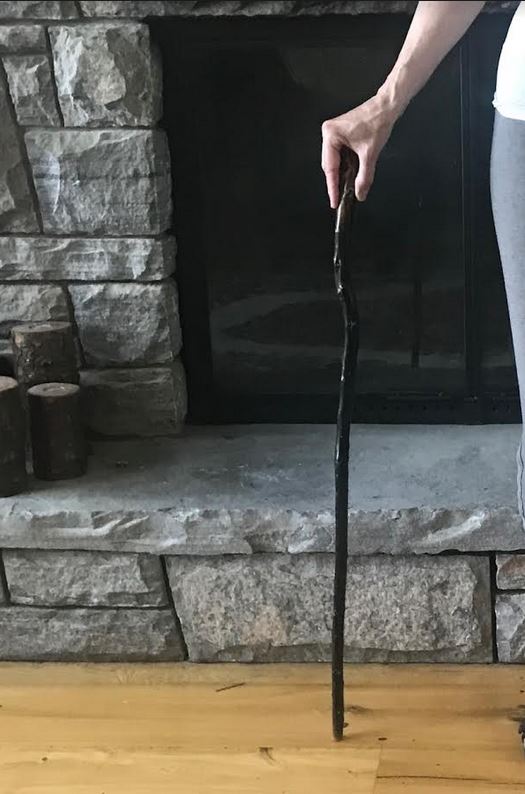
Judy Luker Massey with the family shillelagh in Muskoka, Ontario, Canada.
|
Our family Shillelagh was passed down to my
father, Sam Luker from his mother Gladys Sarah (Hodgins) Luker (1894-1984). We
believe it came over to Canada from Ireland with either her mother’s or
father’s Hodgins, Crawley, Ward, or Culbert family in the mid 1800’s.
The Shillelagh has always stood in my
parents’ bedroom in the corner. I decided that it was about time for me to do
some research about Shillelaghs as I knew very little about them.

Shillelagh is spelled in numerous ways such as Shillelah, Shillalah, and
Shillaly. Many people pronounce it incorrectly as it should be pronounced
“shahall-ay-luh” not “sha-lay-lee.” The cane was originally called an “Irish
Bata” or “Fighting Stick.” Bata in Gaelic means fighting stick. Traditionally
the Shallelagh was a wooden walking stick, club, or cudgel. It was most likely
made of oak and later expanded to be made from holly, ash, or preferably from
the stout, knotty wood of a blackthorn tree.
The blackthorn or in Irish the “Draighean” is a small tree or large bush from
the British Isles. It tends to stand around 12 feet tall but may grow to
approximately 16 feet. It is twisted and thorny with numerous dark coloured
branches that are tough, resilient, and resistant to warping. It has a
plum-like fruit called “sloe” which can be made into a liquor called “slow
gin.” The blackthorn tree also has beautiful white flowers which bloom in the
spring. It is considered excellent for firewood as it smokes little, provides
good heat, and burns slowly. It is found much less frequently in Ireland today
than in the past.
The blackthorn tree has thorns so was often used in Ireland to keep livestock
in and unwanted intruders out. It became the preferred wood from which to make
a Shillelagh because of its beauty, durability, strength, and solid weight. A
knot on the top was valued to make the stick more comfortable to grip when walking
and to increase the likelihood that the stick wouldn’t crack when being used.

A number of sources reference Hugh Bronte, Charlotte Bronte’s Uncle. He
apparently used a chamois and applied magpie blood to the shank of his
Shillelagh to give the stick a darker appearance. Some individuals left the
bark on the stick for added toughness. This was not necessary, however, with
those made from blackthorn root as they were tough enough already.
 |
|
Carrying a Shillelagh was seen as a badge of honour for a man. It was
considered a rite of passage into manhood when a boy received it. It became
popular when Irish and Scottish populations were not allowed to legally carry
weapons for self-defence. To use it as a fighting stick, it was held in the
middle and snapped out from the wrist. It was not swung. Bata was the weapon of
choice for the Irish in the 19th century and earlier and in Gaelic means,
“Fighting Stick.” The author, Arthur Conan-Doyle even had his character
Sherlock Holmes described as a master of single-stick fighting.
Experienced fighters might use two sticks for fighting called “Troid de Bata”
or “Two Stick Fighting.” The second stick was held in the non-dominant hand and
used as a shield. The Shillelagh, Bata, or sticks could be short mallets of
only 1-2 feet long to poles of 6-9 feet in length. Originally the stick was
longer as this allowed the individual to make contact more quickly with his
opponent when fighting. Today, the longer length is not necessary as the Shillelagh
is rarely used for fighting.
The knobby cudgel was used in the past for aiming at the head. Some of the
knobs in the fighting sticks were hollowed out and filled with molten lead
which made them more dangerous. They typically weighed around 2 pounds and were
called loaded sticks. The loaded sticks needed to have the knob fitted with
iron ferrules to maintain its structural integrity. These ferrules could also
be fitted into the narrow end of the stick as well.

The Shillelagh was once used for settling disputes like in a duel with pistols
or swords. Today, slimmer sticks make practical walking sticks. Longer sticks
are often called Wattles and shorter ones Kipeens.
The fighting sticks frequently came out in Ireland at fairs, wakes, or all
Saints feast days. At this time, various groups such as family clusters,
religious factions, or political associations would get together for social
gatherings. Some fights might include as many as 100 men and occasionally a few
women. The women did not use bata but more likely would weld a stocking filled
with stones. After the 1840’s there were many fewer fights. The last recorded
fight I could find was at a fair in the village of Cappawhite, County Tipperary
in 1887.
Some of the fights were often for fun with challenges given out. This could be
done when a man dragged a coat behind him and threw it down. A challenge was
then tossed out, “Who’ll tread on the tail of my coat?”

There is a wide range of information written about the Shillelagh. Bataireacht
studies focus on the use of the Shillelagh for self-defence and as a martial
art. Shillelagh Law is often explained as being the accepted rule governing the
usage of the weapon.
Irish historian, P. W. Joyce and others have commented that the Shillelagh may
have received its name from forest land in the village or barony of Shillelagh,
County Wicklow in Ireland. The forest was once famous for its massive oak
trees. The majority of the oaks, however, were cut down and exported so that
only a few now remain in Ireland. The original oak stick was observed by an
English writer who named it the Shillelagh. This then became the name for a
walking stick starting in 19th century London when it was more commonly used as
a weapon.
I am particularly interested in learning how to determine if a Shillelagh is
authentic. Genuine Shillelaghs, I am told, have deep reddish-bark and numerous
knots. The spurs on the wood are evenly spaced around the cane. When they are
removed small dimples are visible.

It is impossible to know how old our family Shillelagh might be or where
geographically it originated. I will always, however, be fascinated with it and
speculate on whose hands made it and the journey it has taken in order to
finally reside in our home in Canada.
Best wishes to all my Irish cousins,
Judy Luker Massey
“Oh! An Irishman’s heart is as strut as a Shillelagh, it beats with delight
to chase sorrow and woe;
When the piper plays up, then it dances gaily, and thumps with a whack to
leather a foe.”
- Unknown
Questions:
1. Does anyone else in the family have a Shillelagh? If so, what wood is it made
from?
2. If you have a Shillelagh, do you know who made it and from where it
originated geographically?
Please contact me at this email address…