Showing posts with label Culbert - Dana Elizabeth. Show all posts

Monday, 2 August 2021

X-ray Vision: The Fluoroscope Fad

 In a previous post, we saw Mary (Patrick) Culbert (wife of Milward Taylor "Mel" Culbert) walking past the Rowland Hill's Shoe Store in London, Ontario in 1945 with her three-year-old son, Terrence Patrick "Terry" Culbert and her baby daughter, Dana Elizabeth Culbert.

Mary (Patrick) Culbert with son Terry Culbert and daughter, Dana Culbert (in pram) walking by Rowland Hill's Shoe Store on Dundas Street in London, Ontario, 1945.

Terry was probably hoping to drag his mother into the shoe store. Why? So that he could x-ray his feet!

Inside Rowland Hill's Shoe Store was a device known as a fluoroscope or a pedoscope.

Advertisement for Rowland Hill's Shoe Store's X-ray shoe fitting equipment, i.e. fluoroscope. Source: London Free Press, 31 October 1935.
Terry Culbert says, “It was a thrill to use that machine! You could look through the viewer and see the bones of your feet!” His sister, Dana (Culbert) Garrett remembers that “it was the highlight of every shopping trip!

Fluoroscopes began popping up in shoe stores in Canada and the United States during the 1920s. Purported to be a shoe-fitting aid, their popularity lasted for decades. 

X-Ray Shoes sign at a store in St. Petersburg, Florida, 1930s. The bench also says X-Ray Shoes.

Fluoroscope frenzy, 1920s.

As a child in the 1960s, I shared Terry and Dana’s excitement at using that marvel of a machine. I couldn’t wait to run into Rowland Hill’s Shoe Store and slide my feet into the fluoroscope.

1940s Fluoroscope demonstration.

In 1999, Time magazine described the fluoroscope as one of “The Worst Ideas of the Century” but to children, it was a miracle machine.

The fluoroscope stood at about 4 ½ feet high. An x-ray device was concealed within the fluoroscope.

How did it work? First, you tried on a new pair of shoes. Then, you slid your feet into the two slots at the base of the fluoroscope. Next, you peered into one of three viewers at the top of the fluoroscope. You then set a timer, and looked at the image of your feet on a screen. You could clearly see the bones of your feet, glowing green!

If you wiggled your toes, you could see your bones move. It was like watching a dancing skeleton.

As mentioned, the fluoroscope had three viewers at the top. Up to three different people could look at the bones of your feet at the same time. For example, a child could observe the bones of their feet through one viewer while their mother and the salesperson looked through the other two viewers.

The salesperson claimed to be able to see if the shoes fit you properly by looking through the viewer at your bones. However, the proper fit of a shoe is based on the soft tissues of the foot, not the bones. Undoubtedly, the fluoroscope was more of a sales gimmick than a tool.

A section from a shoe salesperson’s fitting card.

According to an article in the University of Chicago’s The History of Social Science, “the shoe-fitting fluoroscope was nothing more or less than an elaborate form of advertising designed to sell shoes.

Not only was the fluoroscope a gimmick, it was a health hazard. Fluoroscopes produced and leaked radiation. Not just a little radiation; A LOT OF RADIATION. The fluoroscope delivered a radiation dose of 13 roentgen. This wasn’t particularly harmful if you only used the machine once or twice a year. However, these were dangerous levels of radiation if you were a fluoroscope enthusiast like me and my siblings, Terry and Dana or if you were a shoe salesperson who was constantly in close proximity to the machines.

By the 1960s, fluoroscopes were banned in the United States but their use carried on in Canada until 1970. 

Fluoroscopes were all the rage with children. Children are much more radiosensitive than adults yet kids begged their mothers to use the shoe store’s fluoroscope. After all, what kid wouldn’t want to see their skeletal feet glowing green?
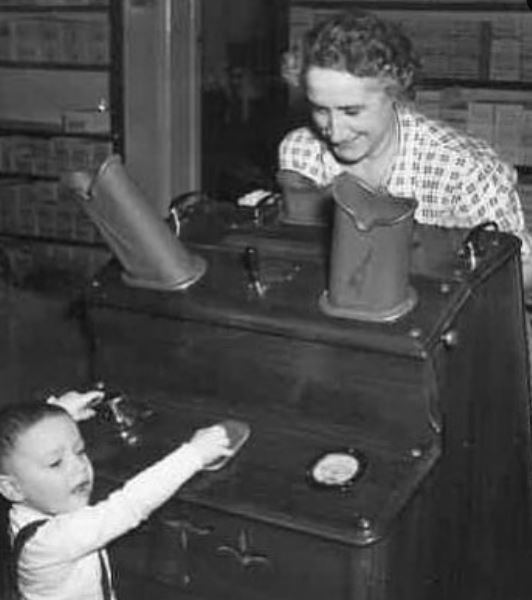
This photo reminds me of my childhood fervor for the fluoroscope. [photo via]

Seriously?

Fluoroscopes were fun but dangerous. There are records of shoe salespersons and customers who suffered radiation burns and foot cancer. Fortunately, Terry and Dana and I (and maybe some of you) have managed to make it this far in life without any known side effects. 

Time magazine really did make a good point when they described the fluoroscope as one of “The Worst Ideas of the Century.

Wednesday, 23 June 2021

Seeking Your Street Photographs

 At the end of this post, you’ll find a homework assignment. But first, here's a little background on street photography.

A street photographer in action. Most street photos were candid although this one looks like it was posed.

Street photographs captured a split second in the lives of thousands of people as they strolled down city streets.

Street photographers made a living by taking candid photos of people walking along urban sidewalks. Pedestrians were captured in mid-stride, going about their day; shopping, on their way to work, chatting with friends or just out for a walk.

After snapping the shutter, the photographer handed you his business card. You could then make arrangements to purchase as many copies of the photo as you wished, after the photographer developed your image. There was no obligation to purchase the photo.

Street photography’s heyday was in the 1930s to the 1950s, a time when not everyone had the money to afford their own camera nor the budget to afford a studio portrait. For a low price, a street photographer could provide you with a photograph and copies for your friends or sweetheart.  

Let’s look at a few examples of street photography. The first two of these examples are from members of the Culbert family…

PHOTO #1:

Ches Culbert (left) in Calgary, Alberta.

Photo #1 (above) is courtesy of Susan (Culbert) Block of Sherwood Park, Alberta, east of Edmonton. Susan is the 2xgreat-granddaughter of John Culbert and Mary Ward. Susan’s great-grandparents were Joseph Culbert and Eliza Dempster.

The photo above shows Susan’s grandfather, John Chester “Ches” Culbert (1891-1969) on the left. The man on the right is probably Ches’s wife’s brother, Edward McHugh. Susan thinks that the photo may have been taken in the early 1960s. Ches and Edward are walking along a street in Calgary. 

Ches Culbert was born in Biddulph Township near Lucan, Ontario but he moved to Calgary around 1912 when he was about 21 years old. Ches Culbert owned and operated a barber shop, and was married to Marie McHugh. Ches and Marie had two sons: Maurice Joseph Culbert (1919-1988) and John Chester "Jack" Culbert (1924-2016).

PHOTO #2:

Mary (Patrick) Culbert with son Terry Culbert and daughter, Dana Culbert (in pram) on Dundas Street in London, Ontario, 1945.

Photo #2 (above) shows Mary (Patrick) Culbert (1917-1989), the wife of Milward Taylor “Mel” Culbert (1920-1958). Mary is accompanied by her son, Terrence Patrick “Terry” Culbert (born 13 May 1942), and her baby daughter (in the pram), Dana Elizabeth Culbert (born 4 August 1945). Mary is walking past Rowland Hill Shoe Store at 203 Dundas Street in London, Ontario; one of London’s most popular shoe stores. Since Mary and Mel lived in the small village of Lucan, they often visited Mary’s hometown of London which offered a greater variety of shopping services. During World War Two, Mel Culbert was posted in Toronto. For a couple of years following WWII, Mel and Mary lived at 183 Rectory Street in London before they returned to Lucan. It was during that time living in London that this photo would have been taken.

Photo #3 (below) is courtesy of Garnet Douglas Haig Thibideau of Courtice, Ontario. Garnet Thibideau was born 1947 in Toronto and raised in London. Although Garnet isn’t a Culbert descendant, he shares some DNA matches with Culbert descendants. It’s possible that Garnet is related to us through a distant Irish ancestor. Garnet’s ancestors are from Biddulph Township, and before that, from Ireland. Garnet has several surnames in his family that are connected to members of the Culbert family. Some of these names are Hodgins, Stanley, Atkinson, Haskett, and Ward. Garnet’s 3xgreat-grandmother was a woman named Margaret (Ward) Stanley (c1792-1869). Whether or not Margaret (Ward) Stanley was related to our Mary (Ward) Culbert (c1810-1888), we don’t know but they both settled in Middlesex County, Ontario from their native Ireland.

PHOTO #3:

Left to right: Mary Evelyn (Stanley) Bowes, her daughter, Zillah Iretta Josephine (Bowes) Harvey/Thibideau; and Zillah’s daughter, Eltamae Ruth Harvey.
 

Photo #3 (above) shows Garnet Thibideau's grandmother, mother, and half-sister in a photo he calls, “Stanley Girls on the Town.” The photo was taken in London, Ontario in the mid-1940s. The store in the background is C. Wallace Co. Ltd., a dry goods store located at 197-199 Dundas Street. This photo was taken just a couple of stores west of the previous photo (photo #2) showing Mary Culbert with her two children.

The next photo gives you an idea of what Dundas Street looked like in 1954, about a decade after photos #2 and #3 were taken ...

The C. Wallace Co. Ltd. store (seen in the background of photo #3) was situated on the south side of Dundas Street between Richmond Street to the west and Clarence Street to the east. The C. Wallace store was next door to Arliss Shoes to the west (195 Dundas Street), and Maher Shoes and Rowland Hill Shoe Store (seen in photo #2) to the east. This section of Dundas Street would have been a popular spot for a street photographer to wait for passers-by because it was in the heart of downtown London. Photo source:
Western Archives London Free Press Collection.

HOMEWORK ASSIGNMENT:

Please look through your old photos and see if you can find any “street photos.” If you find one, please scan it and email it to me at this address…

I’ll publish your street photos on the Culbert Family History blog at a later date.

Saturday, 20 March 2021

"Crafty Culberts" Presents Dana (Culbert) Garrett

Dana Elizabeth (Culbert) Garrett (the great-great-granddaughter of John Culbert & Mary Ward) was born in London, Ontario, Canada on 4 August 1945. She was raised in Lucan, Ontario, and she now lives in London. For more details about Dana, click here.

Here’s Dana to tell you about her interest and arts and crafts…

I’ve always been interested in arts and crafts. When I was younger, I watched my Grandma Patrick and my mother, Mary (Patrick) Culbert do lots of sewing.  As a young wife and mother, myself, I did a lot of sewing for our home from curtains to bedspreads, and clothes for the kids and myself.

I’ve also made quilts, I’ve embroidered, cross-stitched, crocheted, and knit lots of projects over the years.  More recently, with the encouragement of my brother, Terry Culbert and his partner, Barbara Högenauer, I’ve taken up painting with acrylics. This has grown into a wonderful outlet for me in my retirement.  I belong to two local Art clubs, and show and sell my work on a regular basis. 

These are some of my more recent paintings…

Sold

Sold


Sold


I’ve also included images of two different afghans that I knitted as Christmas presents for my daughter, Kathy and my daughter-in-law Heather, after not having knitted for many years. With COVID-19 and being locked down, I rediscovered this old hobby.


Dana Garrett has more paintings available for sale. She can be reached at the following email address:

Thank you, Dana!

DANA ELIZABETH (CULBERT) GARRETT'S FAMILY TREE:

Ancestors:

John Culbert and Mary Ward (great-great-grandparents)

Richard Culbert and Jane Eleanor Fairhall (great-grandparents)

Myron Manford Culbert and Effie Pearl Taylor (grandparents)

Milward Culbert "Mel" Culbert and Mary Elizabeth Patrick (parents)

Descendants (Children):

Jason William Garrett

Katherine Melissa (Garrett) Pritchard