Showing posts with label Luker - Samuel Robert. Show all posts

Wednesday, 10 June 2026

Samuel Robert Luker (1 Jul 1932 - 1 May 2026)

Samuel Robert "Sam" Luker was the great-great-grandson of John Culbert and Mary Ward. 

Sam Luker and his wife Melva (Murphy) Luker.

The following is Sam Luker's obituary, published in GuelphToday:


Samuel Robert Luker
1 Jul 1932 – 1 May 2026

Samuel Robert Luker passed away peacefully on Friday morning, two months shy of his 94th birthday, surrounded by the family he loved so deeply.

Born in London, Ontario, Sam lived a life defined by curiosity, intellect, compassion, and quiet adventure. He attended Western University, where he completed both his undergraduate and graduate studies in Psychology, earning the University’s Gold Medal for highest academic achievement in his field - an early reflection of the insight and dedication that would shape his lifelong work.

Sam’s career was both varied and meaningful. He was a teacher, Chief Psychologist with the Wellington County Board of Education, a professor at the University of Guelph, a Family Court mediator, and a psychologist in private practice. He was also a trailblazer in the field of human sexuality, approaching his work with openness, respect, and a deep belief in understanding others without judgment. At his core, he was a peacemaker - thoughtful, measured, and wise.

Beyond his professional life, Sam was an adventurer at heart. He travelled to all seven continents and visited 94 countries, embracing the world with wonder - from Antarctica to Zaire and countless places in between. He demeanour and all who knew him often said, a philosopher’s life: introspective, calm in demeanour, and guided by a steady sense of love and curiosity.

He will be remembered as an extraordinary husband, father, grandfather, brother, uncle, and friend. Sam was predeceased by his twin brother Richard and beloved wife of more than 65 years, Melva Murphy Luker, with whom he shared a deep and enduring partnership.

He leaves behind his daughters, Judy Massey (Dave) and Jana Luker (Robert Johnston). He was a proud and loving grandfather to Christopher and Brett Massey, great grandfather to Hudson & Lennox Massey and a deeply adored “Poppy” to Emma Luker (Jason Asnis) and Kai Luker (Greg Seraphim).

Sam’s presence was steady and comforting, his wisdom quietly offered, and his love deeply felt. He leaves behind a legacy of kindness, curiosity, and connection that will continue to ripple through the lives of all who knew him.

He will be profoundly missed.

Our family will gather to celebrate Sam’s life later this summer

In lieu of flowers, please consider a donation to the Melva Murphy Luker Camp Kitchikewana Endowment Fund or Hospice Muskoka.

- end of obituary - 

Twin brothers, Dick Luker (left) and Sam Luker (right) born July 1, 1932 in London, Ontario.


Please click here to read a biography of Sam Luker and his twin brother, Dick Luker, as written by Sam's daughter, Judith Luker Massey.

To read a biography of Sam Luker's mother, Gladys Sarah (Hodgins) Luker, click here. 

Note: If you were a student at Lucan Public School in Lucan, Ontario during the 1950s, you may remember Sam Luker as one of your teachers.

SAM LUKER'S FAMILY TREE:
Ancestors:
John Culbert & Mary Ward (great-great-grandparents)
Susan Culbert & Philip Crawley (great-grandparents)
Sarah Catherine Crawley & Samuel Hill Hodgins (grandparents)
Gladys Sarah Hodgins & Wilbert Luker (parents)

Descendants (Children):

Judith (Luker) Massey

Jana (Luker) Johnston

Tuesday, 17 June 2025

Richard James "Dick" Luker (1932-2025)

Richard James "Dick" Luker was the great-great-grandson of John Culbert and Mary Ward.


Dick Luker died 30 March 2025 in Windsor, Ontario, Canada, age 92. His niece, Judith Luker Massey wrote the following piece in his memory. Information for this piece was reviewed and provided by her father, Sam Luker (Dick Luker's brother.)

Dick Luker (left) and Sam Luker (right) born 1 July 1932 in London, Ontario, Canada.
 

Dad (Sam) and Uncle Dick were fraternal twins and they had a close bond. The twins were born July 1, 1932 in London, Ontario and were told by their mother, when they were young boys, that the Dominion Day parades and fireworks (later known as Canada Day) were really for their birthday.

Their mother Gladys (Hodgins) Luker did not realize that she was having twins. After Dick was born, the doctor said, “It is not over yet Gladys,” and Sam was born 11 minutes after. The twins often had friendly discussions about who was really the oldest. Sam almost died at birth from pneumonia and their mother Gladys said that Dick cried all the time Sam was in the hospital.

Dick and Sam's mother, Gladys (Hodgins) Luker (1894-1984). Gladys was the great-granddaughter of John Culbert & Mary Ward.

Sam and Dick skipped two grades and were placed into one of the first gifted classes in Ontario. They graduated high school when they were 15. They then went to London Normal School (a teachers college) and started teaching in one-room rural school houses not far from each other near Windsor.

Dick married Anne Taylor whom he met at Teacher’s College. Anne was from Windsor and so they settled down there, and Dick became a banker in Detroit, Michigan. Dick eventually became a vice-president.

Sam went to Western University in London (formerly the University of Western Ontario,) and after completing grad school, Sam became a clinical psychologist and then a professor of Family Studies at the University of Guelph. Sam married Melva Murphy from Midland, Ontario who worked as a nurse and supported him while he went to university. A scholarship and Melva’s nursing kept the young couple solvent.

Sam and Dick both liked to travel. Sam has calculated that he and Melva visited 95 different countries.

The two brothers also both enjoyed music. Sam liked pop standards and classical music while Dick had extensive knowledge and a collection of Dixieland Jazz. Dick was often contacted by radio stations and other groups to share information and borrow a record from his very large Dixieland record collection.

Both twins were bright, articulate and had happy childhoods and marriages. Although Dick lived in Windsor and Sam in Guelph, they remained close. With children and busy careers, they were not able to see each other as much as they wished. However, when they were able to get together, they talked nonstop and always had lots to share.

Dick’s death on March 30, 2025 was a blow to Sam. Dick had been calling out for Sam. Although Dick was lying down and not responsive, when he heard Sam’s voice on the phone, he opened his eyes and smiled. This was the last time the twins had an opportunity to connect before Dick died. 

- End -

To read more about Dick Luker and his brother, Sam, and to see additonal photographs, let's return to a previous post on the Culbert Family History blog. Click here to read about Dick and his twin brother, Sam Luker. Dick's obituary can be found here.

DICK LUKER's FAMILY TREE:
Ancestors:
John Culbert & Mary Ward (great-great-grandparents)
Susan Culbert & Philip Crawley (great-grandparents)
Sarah Catherine Crawley & Samuel Hill Hodgins (grandparents)
Gladys Sarah Hodgins & Wilbert Luker (parents) 

Descendants (Children): 

Leslie (Luker) Agnew

Tim Luker 

Friday, 1 July 2022

Happy 90th Birthday, Dick and Sam Luker!

Happy birthday to Richard James Luker and Samuel Robert Luker!

Brothers, Dick Luker and Sam Luker were born 1 July 1932 in London, Ontario, Canada. Click image to enlarge.

If you missed their biography, click here.

SAM & DICK LUKER'S FAMILY TREE:
Ancestors:
John Culbert & Mary Ward (great-great-grandparents)
Susan Culbert & Philip Crawley (great-grandparents)
Sarah Catherine Crawley & Samuel Hill Hodgins (grandparents)
Gladys Sarah Hodgins & Wilbert Luker

Monday, 18 January 2021

The Family Shillelagh

This post was written by Judy Luker Massey, the 3xgreat-granddaughter of John Culbert and Mary Ward.

THE FAMILY SHILLELAGH

by Judy Luker Massey

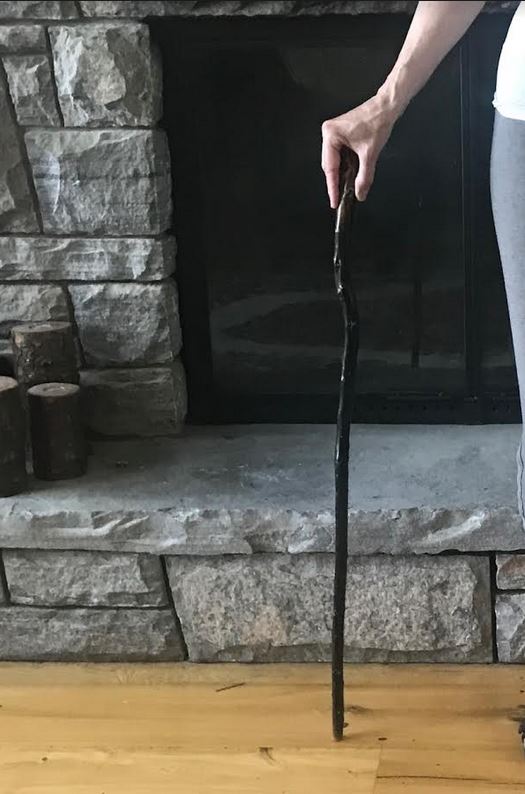
Judy Luker Massey with the family shillelagh in Muskoka, Ontario, Canada.

Our family Shillelagh was passed down to my father, Sam Luker from his mother Gladys Sarah (Hodgins) Luker (1894-1984). We believe it came over to Canada from Ireland with either her mother’s or father’s Hodgins, Crawley, Ward, or Culbert family in the mid 1800’s.

The Shillelagh has always stood in my parents’ bedroom in the corner. I decided that it was about time for me to do some research about Shillelaghs as I knew very little about them.

Shillelagh is spelled in numerous ways such as Shillelah, Shillalah, and Shillaly. Many people pronounce it incorrectly as it should be pronounced “shahall-ay-luh” not “sha-lay-lee.” The cane was originally called an “Irish Bata” or “Fighting Stick.” Bata in Gaelic means fighting stick. Traditionally the Shallelagh was a wooden walking stick, club, or cudgel. It was most likely made of oak and later expanded to be made from holly, ash, or preferably from the stout, knotty wood of a blackthorn tree.

The blackthorn or in Irish the “Draighean” is a small tree or large bush from the British Isles. It tends to stand around 12 feet tall but may grow to approximately 16 feet. It is twisted and thorny with numerous dark coloured branches that are tough, resilient, and resistant to warping. It has a plum-like fruit called “sloe” which can be made into a liquor called “slow gin.” The blackthorn tree also has beautiful white flowers which bloom in the spring. It is considered excellent for firewood as it smokes little, provides good heat, and burns slowly. It is found much less frequently in Ireland today than in the past.

The blackthorn tree has thorns so was often used in Ireland to keep livestock in and unwanted intruders out. It became the preferred wood from which to make a Shillelagh because of its beauty, durability, strength, and solid weight. A knot on the top was valued to make the stick more comfortable to grip when walking and to increase the likelihood that the stick wouldn’t crack when being used.

The wood for a Shillelagh might be cured up a chimney for several months or even years. It should preferably be dried for at least a year. The build-up of soot will over time give the Shillelagh its frequently shiny black appearance. Other methods to cure the wood and prevent the wood from splitting during the drying process were to bury the shank in a manure pile or in slack lime and to smear it with butter. Some references suggest that during a dung bath the shank would be well greased and wrapped with oiled brown paper that was steeped in hog’s lard or oil. Then, another coat of special soot finish or a mixture of black lead paint was added to it. An alternative, although much rarer, was brining where the shank was placed into a basin of salt water to pull the moisture from it to avoid warping.

A number of sources reference Hugh Bronte, Charlotte Bronte’s Uncle. He apparently used a chamois and applied magpie blood to the shank of his Shillelagh to give the stick a darker appearance. Some individuals left the bark on the stick for added toughness. This was not necessary, however, with those made from blackthorn root as they were tough enough already.


Carrying a Shillelagh was seen as a badge of honour for a man. It was considered a rite of passage into manhood when a boy received it. It became popular when Irish and Scottish populations were not allowed to legally carry weapons for self-defence. To use it as a fighting stick, it was held in the middle and snapped out from the wrist. It was not swung. Bata was the weapon of choice for the Irish in the 19th century and earlier and in Gaelic means, “Fighting Stick.” The author, Arthur Conan-Doyle even had his character Sherlock Holmes described as a master of single-stick fighting.

Experienced fighters might use two sticks for fighting called “Troid de Bata” or “Two Stick Fighting.” The second stick was held in the non-dominant hand and used as a shield. The Shillelagh, Bata, or sticks could be short mallets of only 1-2 feet long to poles of 6-9 feet in length. Originally the stick was longer as this allowed the individual to make contact more quickly with his opponent when fighting. Today, the longer length is not necessary as the Shillelagh is rarely used for fighting.

The knobby cudgel was used in the past for aiming at the head. Some of the knobs in the fighting sticks were hollowed out and filled with molten lead which made them more dangerous. They typically weighed around 2 pounds and were called loaded sticks. The loaded sticks needed to have the knob fitted with iron ferrules to maintain its structural integrity. These ferrules could also be fitted into the narrow end of the stick as well.


The Shillelagh was once used for settling disputes like in a duel with pistols or swords. Today, slimmer sticks make practical walking sticks. Longer sticks are often called Wattles and shorter ones Kipeens.

The fighting sticks frequently came out in Ireland at fairs, wakes, or all Saints feast days. At this time, various groups such as family clusters, religious factions, or political associations would get together for social gatherings. Some fights might include as many as 100 men and occasionally a few women. The women did not use bata but more likely would weld a stocking filled with stones. After the 1840’s there were many fewer fights. The last recorded fight I could find was at a fair in the village of Cappawhite, County Tipperary in 1887.

Some of the fights were often for fun with challenges given out. This could be done when a man dragged a coat behind him and threw it down. A challenge was then tossed out, “Who’ll tread on the tail of my coat?”


There is a wide range of information written about the Shillelagh. Bataireacht studies focus on the use of the Shillelagh for self-defence and as a martial art. Shillelagh Law is often explained as being the accepted rule governing the usage of the weapon.

Irish historian, P. W. Joyce and others have commented that the Shillelagh may have received its name from forest land in the village or barony of Shillelagh, County Wicklow in Ireland. The forest was once famous for its massive oak trees. The majority of the oaks, however, were cut down and exported so that only a few now remain in Ireland. The original oak stick was observed by an English writer who named it the Shillelagh. This then became the name for a walking stick starting in 19th century London when it was more commonly used as a weapon.

I am particularly interested in learning how to determine if a Shillelagh is authentic. Genuine Shillelaghs, I am told, have deep reddish-bark and numerous knots. The spurs on the wood are evenly spaced around the cane. When they are removed small dimples are visible.


It is impossible to know how old our family Shillelagh might be or where geographically it originated. I will always, however, be fascinated with it and speculate on whose hands made it and the journey it has taken in order to finally reside in our home in Canada.

Best wishes to all my Irish cousins,
Judy Luker Massey

“Oh! An Irishman’s heart is as strut as a Shillelagh, it beats with delight to chase sorrow and woe;
When the piper plays up, then it dances gaily, and thumps with a whack to leather a foe.
”
- Unknown
 

Questions:

1. Does anyone else in the family have a Shillelagh? If so, what wood is it made from?

2. If you have a Shillelagh, do you know who made it and from where it originated geographically?

Please contact me at this email address…

Thursday, 13 December 2018

Sam Luker's African Adventures

Today, we present a travelogue written by globetrotting Culbert descendant, Sam Luker of Muskoka, Ontario. Take it away, Sam!

OUR AFRICAN ADVENTURES by Sam Luker

Sam Luker in Rwanda
In November of 1985, after spending time in Israel and Egypt, my wife Melva and I flew to Dar el Salaam, Tanzania, then on to Mount Kilimanjaro. Although the tallest mountain in Africa, Mt. Kili is not technically a difficult ascent. But the altitude (19,341 feet above sea level) is a killer! Even though we spread the climb over several days, it was exhausting. But we did it!   

Sam Luker climbing Mount Kilimanjaro
We then flew to Nairobi, Kenya (I had some university business to do there); then on to Burundi, where we picked up our safari and headed for Zaire (now Congo) to see the rare Mountain Gorillas, and hopefully meet the famous "Gorilla Lady" Dian Fossey in Karioke, Rwanda.

That night, our group was arrested by the government militia and carted off to a deserted village! All night long our tent camp was encircled by soldiers armed with AK47s. In the morning, they explained that it was all just a small misunderstanding. They actually thought  we might have been mercenaries who crossed into Zaire on the anniversary of their glorious revolution!! When our daughters heard the story, they thought it was hilarious. One said "Yea Dad, mercenaries with bi-focals". Not funny.
Sam Luker camping in Rwanda
We did have a very successful interaction with the gorillas, both in Zaire and Rwanda. We were able to get up close and personal with several families, a glorious experience. Unfortunately, Ms. Fossey refused to see us (or any other tourists.) She had made enemies of some of the local poachers and government officials, and was already under the protection of an armed guard when we were there.   

A rare Mountain Gorilla
On our flight home, we received the tragic news that she had been murdered (likely by an agent of the same corrupt government official.) So ended our first excursion into mysterious Africa.
Our second African trip took place in October of 1997. We travelled to South Africa, Losotho, Swaziland and Namibia; primarily to view the wonderful display of wildlife there. The national parks of South Africa and Namibia were particularly impressive. We saw elephants, lions, hippos, rhinos, zebras, gazelles, ostriches, gnus, and countless exotic bird species.
    
We stayed an extra few days in Capetown, South Africa; a most attractive city. We climbed the world-famous Table Mountain which provided us with an incredible view of the city and its surroundings.

All in all, another fine trip. We recommend Africa to anyone with a yen to see the natural world.

---

Thanks, Sam!

If you have a travel story to share with us, please contact me at this email address:

Monday, 19 November 2018

Travelling the World with Sam Luker

The Culbert Family History blog presents the first of what we hope will be many travelogues written by you, the descendants of John Culbert and Mary Ward.

Today's story comes to us from Sam Luker of Muskoka, Ontario whom you met previously in this post. 

Sam Luker and Melva Murphy in 1955 as they embarked on a lifetime of adventure together.

TRAVELLING THE WORLD by Sam Luker

In our sixty-three years together, my wife, Melva and I have travelled the world widely, visiting over eighty-five countries on all seven continents. The early years were spent exploring the Caribbean Islands and Mexico with our young children, by land and by chartered sailboat. Later we sailed on our own yachts throughout the Great Lakes.

We then expanded our horizons to include much of Europe (Portugal, Italy, France, Britain, Belgium and eastern Europe). My sabbaticals from the University of Guelph allowed us to travel extensively throughout China and Japan, the South Pacific (Bali, Indonesia, Australia, New Zealand and Thailand). We did an exchange with the University of Colombia, after which we explored the Amazon River, the Galapagos Islands and Machu Pichu.                                                                                                 
Upon my early retirement from the University of Guelph, I travelled to Antarctica, Argentina and Brazil.                                                                                                        
In later years, we travelled through the western United States, across Canada coast to coast, and explored Iceland. We made two trips to Africa. On one trip, we were briefly arrested by the militia in Congo.                                                                    
We also tried cruising for the first time. This deluxe trip took us from Stockholm north on the Adriatic Sea to St. Petersburg Russia, stopping off at Finland, Latvia and Lithuania before sailing south to Copenhagen, Denmark. We followed this up with a land excursion through Norway (most rewarding).

Having had a taste for cruising, we next embarked on three river boat trips: the Danube, Rhine and Elbe. Though lacking the five-star service of the first cruise (with a butler yet), they proved to be most enjoyable.

Two years ago, we made a sentimental trip back to the land of my ancestors in Southern Ireland, and attended an Irish wedding there.

Lately, we have slowed down a little, but we managed to attend our great-nephew's wedding on Vancouver Island. It was great. And believe me, we are not through yet!