If you're Canadian, Lucan-Biddulph's most famous feuding family needs no introduction. But to those of you from abroad, this is one of Canada's most fascinating true crime stories. It's the stuff of song, stage, and film. And it all took place near the Culbert homestead in Biddulph Township near Lucan, Ontario.
 |
| A postcard depicting the Donnellys |
THE CHARACTERS
The notorious Donnelly family lived about two and a half miles east (4 km) and almost straight across from the home of our ancestors:
John Culbert, his wife
Mary (Ward) Culbert, and their sons and daughters.
The Culberts lived on Lot 19, Concession 2 (the Coursey Line) and the Donnellys lived on Lot 18, Concession 6 (the Roman Line.) The name of the road came from the families who lived there: Irish Roman Catholics such as the Donnellys. Our Culbert family, on the other hand, were Irish Protestants.
 |
| Modern image of The Roman Line in Biddulph Township, on the southern outskirts of Lucan. St. Patrick's Roman Catholic Church and Cemetery in background. |
James Donnelly, Sr., the patriarch of the family came to Canada from Tipperary, Ireland in 1842, two years after the Culberts settled here from Ireland. James Donnelly worked for awhile in London, Ontario and London Township, and by 1847 he'd settled on a plot of land on The Roman Line.
 |
| James Donnelly, Sr., the patriarch of the family. This sketch was created shortly after Donnelly's death in 1880 by famous Canadian portrait artist, Robert Harris. |
James Donnelly, Sr. and his wife Johannah raised seven sons and a daughter who were contemporaries of the sons and daughters of John Culbert and Mary Ward.
From the 1850s through to the 1880s, Lucan had a reputation as "the most lawless town in Canada" and "the wildest town in Canada." Lucan had a wild-west feel to it, back then.
 |
| Typical street scene in Lucan c1875. This photo shows Bernard (Barney) Stanley's Cash/Hardware Store. Stanley was the wealthiest man in town, and an enemy of the Donnellys. |
The sons of John Culbert & Mary Ward used to go into town (Lucan) and "clean up" the taverns for fun; just get into a really good brawl for entertainment. It's said the Culberts were "a wild bunch of boys." But the wildest bunch of all were the Donnellys.
 |
| The sons of John Culbert & Mary Ward circa 1865. "A wild bunch of boys." Left to right: Henry, William, Thomas, Joseph, and Richard. |
The Donnelly brothers were handsome and enterprising young men who operated a fiercely competitive stage coach line from Exeter to London.
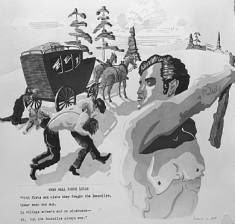 |
| Illustration by Terry Culbert depicting a Donnelly fight. |
With their reputation as ladies' men and successful entrepreneurs, jealously played a part in the resentment they faced from many of the locals. The Donnellys weren't above using their fists to settle an argument and as a result, they were blamed for the many robberies, arsons and assaults in the township, whether or not they were actually responsible for the crimes.
There's much more to be said about the reasons and the events leading up to the "Biddulph Tragedy" but to make a long story shorter, let's fast forward to the night of February 3rd, 1880.
THE MASSACRE
 |
| Headline in the Exeter Times, 5 Feb 1880, page 1. |
The time? Just past midnight on February 4th, 1880.
A Vigilance Committee comprised of about 35 men (many of them inebriated) made their way in the darkness along the Roman Line to the Donnelly homestead, armed with guns, pitchforks, axes, and shovels. The angry mob brutally massacred five members of the Donnelly family and burned the homestead to the ground.
The mob then went to the home of Will Donnelly, further up the road, planning to kill him. When the door opened, they shot and killed his brother, John who was spending the night at Will's house. Thinking they'd killed Will, the ringleader of the family, the murderers left the scene of the crime and went off to celebrate.
THE AFTERMATH
Six members of the Vigilance Committee were arrested but despite two trials, the jury wouldn't deliver a guilty verdict, and the murderers went free.
In 1889, a tombstone was erected on the Donnelly grave at St. Patrick's Roman Catholic Cemetery on the Roman Line.
 |
| The original Donnelly tombstone. This photo doesn't show the full height of the stone which is considerably higher than pictured. If you squint, you can see the word "Murdered" under each name. |
The tombstone became a popular attraction, attracting thousands of tourists, many who chipped away pieces of the stone as souvenirs, and were said to have caused damage to the church property. Owing to ongoing vandalism, and the fact that the priest didn't want the publicity, the original tombstone was removed in 1964 and replaced. Donnelly family members erected a new tombstone and replaced the word "Murdered" engraved under the names of each victim, with the word "Died."
 |
| Me (Mary Jane Culbert) in the late 1990s with the replacement headstone at St. Patrick's Catholic Church Cemetery. The word "Murdered" under each name has been replaced by the word "Died." |
A replica of the original tombstone is on display at the
Lucan Area Heritage and Donnelly Museum in Lucan, Ontario.
 |
| Replica of original tombstone on display at the Donnelly Museum in Lucan. |
THERE'S SO MUCH MORE
One blog post alone such as this can't do the Donnelly story justice. I've only summarized what is a much more involved and compelling tale. There's a good one-page account of the story
here on the Donnelly Museum website. And speaking of the Donnelly Museum, be sure to visit the museum if you're passing through Lucan, Ontario. It's open May to September and it's worth taking the time to look around.
 |
| Lucan Area Heritage & Donnelly Museum on Main Street, Lucan, Ontario. |
 |
| Replica of the Donnelly's log cabin on the grounds of the Donnelly Museum. |
For further in-depth reading, I suggest "The Donnelly Album: The Complete and Authentic Account Illustrated With Photographs of Canada's Famous Feuding Family" by Donnelly authority Ray Fazakas; and its follow-up companion volume, "In Search of the Donnellys."
 |
| The Donnelly Album is the definitive book about The Donnellys. |
THE CULBERTS WHO KEEP THE STORY ALIVE
Terrence Patrick "Terry" Culbert, a Culbert descendant (and my brother) who grew up in Lucan, has written about the Donnellys. A section of
"Terry Culbert's Lucan: Home of the Donnellys" is devoted to the Donnellys. Terry's book is available online or in person through
Attic Books in London, Ontario, and through the Lucan Area Heritage and
Donnelly Museum in Lucan, Ontario.
UPDATE: Terry's book sold out and is now out of print.
 |
| Artist/author, Terry Culbert |
Another Culbert descendant who grew up in Lucan, Jeff Culbert (my first cousin) wrote and starred in the one-man play, The Donnelly Sideshow. The story is told from the point of view of the only eye-witness to the massacre: 13-year-old Johnny O'Connor. Johnny hid under the bed as the attacks took place. Jeff, who performed the role of a grown-up Johnny O'Connor, also wrote songs to accompany the play. The Donnelly Sideshow premiered in 2011 and toured Canada. Jeff grew up on the same street in Lucan where Johnny O'Connor lived.
 |
| Jeff Culbert in The Donnelly Sideshow |
Jeff directed The Donnelly Trial by Christopher Doty in 2005. The play took place at the Middlesex County Courthouse in London, Ontario in the same room where the original Donnelly trial took place.
 |
| It was here at the old Middlesex County Courthouse that the Donnelly trials took place. |
Jeff Culbert's latest production is a concert, "The Wildest Town in Canada" based on songs written about the Donnellys. It includes songs written by Stompin' Tom Connors, Earl Heywood, Maria Dunn, James Boyle, and of course, Jeff Culbert, himself. The show premiered at the Thorndale Community Centre in the summer of 2018, and is booked for a week-long run at Port Stanley Festival Theatre in the spring of 2019.
 |
| Jeff Culbert: Playwright, director, actor, singer, songwriter, musician. Yeah, he pretty much does it all. |
THE DONNELLY-CULBERT CONNECTION
As mentioned, the sons of our John Culbert & Mary Ward were
contemporaries of the Donnellys. The Donnelly brothers were born over
the period ranging from 1841 to 1854. The Culbert brothers were born
over the period ranging from 1837 to 1853.
It's likely that all the Culbert brothers knew the Donnelly brothers regardless of the fact that they attended different churches and different schools. Their properties were only a couple of miles apart and they would have mingled with them in town (Lucan) and at the local taverns.
One Culbert in particular had dealings with the Donnellys.
Thomas Culbert (born 1846 on the Culbert homestead on Biddulph's Coursey Line) owned and operated a livery (a boarding stable for horses) in Lucan. Tom was also the proprietor of the Central Hotel in the nearby village of Granton. It was at Tom's hotel that the Donnellys often stopped for a drink or two.
 |
| Thomas "Tom" Culbert c1865. |
You already know from this previous post that Tom Culbert was a gambling man. And so our Tom Culbert was drawn into a bet involving Tom Donnelly (the rowdiest Donnelly) and an outsider named Hugh McKinnon.
McKinnon was a heavy weight champion who stood six foot three and weighed 215 pounds. McKinnon was also a private detective, hired to keep watch over the Donnellys. McKinnon tried to ingratiate himself with the Donnelly brothers but the Donnellys sussed out his plan.
In a scheme to make some fast cash, the Donnelly brothers set up a ruse with McKinnon. The Donnellys spread the word that this stranger in town (McKinnon) could beat the daylights out of Tom Donnelly. The villagers placed heavy bets on Donnelly to win. The Donnellys however, with the help of some accomplices, covered all bets.
The London Free Press reported on the fight, adding that McKinnon “gave Donnelly such a blow as sent him sprawling out of the door where he lay for some time as if dead.”
Tom Culbert (one of the gamblers) was furious about the set-up. So Tom Culbert and Rhody Kennedy (a one-armed police constable) confronted Tom Donnelly and his brother, Bob Donnelly. Accusing the Donnellys of fraud, Culbert and Kennedy demanded that the Donnellys return the money to the duped villagers. Culbert was told to “go to hell” and a fight broke out between Culbert and the two Donnelly brothers. After the Donnellys had flattened Tom Culbert, they set in on the one-armed Rhody Kennedy who obviously couldn’t defend himself.
 |
| Brothers Bob Donnelly (left) and Tom Donnelly. Our Tom Culbert brawled with these brothers. Photo from the cover of Ray Fazakas' book, The Donnelly Album. |
For a much more detailed account of this set-up and Tom Culbert’s involvement, see Chapter 16 “McKinnon” of Ray Fazakas’ book, "The Donnelly Album: The Complete and Authentic Account Illustrated With Photographs of Canada's Famous Feuding Family." And be sure to check the index of that book for more references to Thomas Culbert.
Yet another account of a scuffle between Tom Donnelly and Tom Culbert comes from Tom Culbert's grandson, Milton Richard Culbert in his book, The Culbert Chronicles.
Milton Culbert relates how Tom Donnelly walked into Thomas Culbert's hotel and had one drink too many. A drunken Tom Donnelly asked for another drink and our Tom Culbert refused him. A fistfight ensued. Donnelly later apologized to Culbert for his behaviour and the two remained on friendly terms.
And so ends my account of The Donnellys and their connection to our Culbert family.
COMING SOON
More about the life of Thomas Culbert in the next post.
 |
| Thomas Culbert in his later years. |


