Showing posts with label Culbert - Ethel Gertrude. Show all posts

Monday, 20 March 2023

Springtime in the Orchard

 Ethel Gertrude (Culbert) Gras (1886-1986), the granddaughter of John Culbert and Mary Ward, published a book of her poetry, Poems and Rhymes.

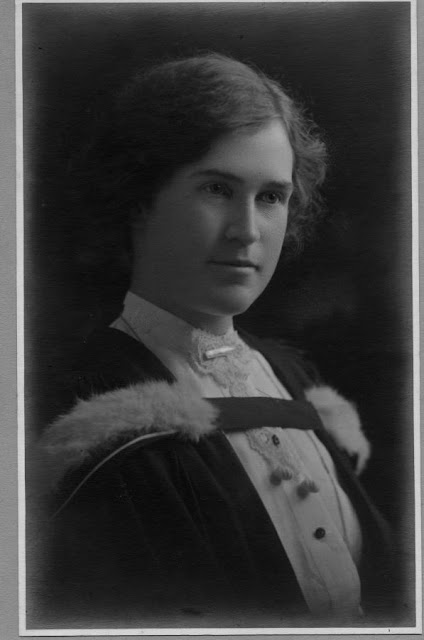
Ethel Culbert in the springtime of  her life. Ethel graduated from Victoria University at the University of Toronto with an A.B. Degree with honors. Photo courtesy of Ethel's granddaughter, Jane (Gras) Heigis.

Ethel, the daughter of Richard Culbert and Jane Eleanor Fairhall, grew up on the Culbert homestead near Lucan, Ontario, Canada on the Coursey Line. She later made her home in the United States with her husband, Norman Scott Brien Gras.

Today, let's welcome the first day of spring, 2023 with Ethel's poem, Springtime in the Orchard.


Ethel Gertrude (Culbert) Gras' Family Tree:

Ancestors:

John Culbert and Mary Ward (grandparents)

Richard Culbert and Jane Eleanor Fairhall (parents)

Ethel Gertrude (Culbert) Gras

Descendants (Children):

Edwin Culbert Gras

Ranulf Worcester Gras

Alfred Edward Gras

Jane London Gras

Sunday, 20 March 2022

Springtime by Ethel (Culbert) Gras

Ethel Gertrude (Culbert) Gras (1886-1986), the granddaughter of John Culbert and Mary Ward, published a book of her poetry, Poems and Rhymes.

Ethel Culbert in the springtime of  her life. Photo courtesy of Ethel's granddaughter, Jane (Gras) Heigis.

Click here if you missed Ethel's love poem to her husband, Norman Scott Brien Gras.

Today, we welcome the first day of spring, 2022 with Ethel's poem, Springtime.


Ethel Gertrude (Culbert) Gras' Family Tree:

Ancestors:

John Culbert and Mary Ward (grandparents)

Richard Culbert and Jane Eleanor Fairhall (parents)

Ethel Gertrude (Culbert) Gras

Descendants (Children):

Edwin Culbert Gras

Ranulf Worcester Gras

Alfred Edward Gras

Jane London Gras

Tuesday, 9 March 2021

Calling All Crafty Culberts!

The John Culbert - Mary Ward family brought with them from Ireland a spinning wheel.
Image found online. Image does not contain actual Culberts.

Ethel (Gras) Culbert (1886-1996) said, "Many a time I sat fascinated as I watched my mother spin the carded rolls of wool with which she knit socks and stockings for the whole family."[1]

Ethel's mother, Jane (Fairhall) Culbert cleaned the wool from her flock of sheep on Poplar Farm near Lucan, Ontario, and had it carded at a mill. Then she spun it into yarn for weaving blankets and for knitting socks for men and stockings for the children.[2] 

Jane Eleanor (Fairhall) Culbert (1858-1949). Crafter extraordinaire.


Ethel continues, "One thing I never could forgive her for was her insistence on my wearing homemade woolen stockings that drove me nearly crazy, the way they itched my legs. Of course it was her chief concern that her children should be warm, when walking two or more miles off to school [Atkinson's School] on cold and stormy winter days. She would not listen to my protest, saying "Now you'll get used to them," but which I never did, vowing that I never could be half so cruel to children of my own."[3]

Ethel says her mother did much sewing and knitting for little ones as they grew up, even unto the fourth generation of Culberts. "She was always making quilts, such nice designs in patchwork... She did nice crocheting, edgings mostly for pillow cases, and some doilies."[4]

"She braided rugs. In early days she sewed together strips of rags and hand them woven into carpets, some were dyed to make a pattern, and this was the only floor covering we knew in the old log house. The carpet was padded underneath with straw and tacked close to the wall."[5]

CALLING ALL CRAFTY CULBERTS!

Do you create any of the following arts and crafts?

Knitting, crocheting, quilting, sewing, embroidering, pottery, woodcraft/carpentry, metalwork, brewing your own beer, painting, drawing, making jewellery or creating other handcrafted items? 

If so, please email a few photos of your handiwork to me, Mary Jane Culbert, with a description of what you've made. If you sell your work online or in a gallery, please provide a link.

I'll put together a post (or posts) to showcase the arts and crafts of modern-day Culbert descendants. 

Note: This invitation to submit photos is open to the descendants of John Culbert & Mary Ward and also to the spouses and partners of those descendants. This invitation is also open to other families who are connected, however distantly, to the descendants of John Culbert and Mary Ward. 

My email address:

Footnotes:

[1]Stories From Life by Ethel Gertrude Culbert Gras, page 49. 
[2] ibid. page 94.
[3] ibid. page 94.
[4] ibid. page 101.
[5] ibid. page. 101. 

Friday, 1 January 2021

A New Year's Greeting to My Love by Ethel (Culbert) Gras

Ethel Culbert's love, Norman Gras.

Ethel Gertrude (Culbert) Gras (2 March 1886 - 21 April 1986) composed this poem for her husband, Norman Scott Brien Gras on New Year's Day, 1 January 1946. By this time, they had been married more than 30 years.

A NEW YEAR’S GREETING TO MY LOVE

              1 January 1946.

Norman dearest, husband of mine,

I greet you, I wish you a Happy New Year

In this very inadequate juvenile rhyme

That expresses some sentiments deep without fear.


Of course I am prejudiced far beyond measure

In the strength and wisdom of such a great man –

Both author and teacher.  But more do I treasure

Your honor, integrity, courage so calm.


The years have been many; the ups and downs, too,

We have been busy and we have been gay.

Life has been happy while journeying with you.

Forward we look to a still brighter day.


It is hard for me here to precisely declare

How much I do love and adore you, my dear.

About that, of course, you’re already aware,

So together we’ll toast to a Happy New Year.


Source: Poems and Rhymes by Ethel Gertrude (Culbert) Gras.

Ethel (Culbert) Gras, 1943. Photo courtesy of Jane (Gras) Heigis.

I’m hoping that some day, one of Ethel’s descendants will write a biographical piece for us about Ethel (Culbert) Gras. Ethel was a bright and engaging author/painter/poet and granddaughter of John Culbert and Mary Ward.

In the meantime, here’s a little background about Ethel and Norman’s love affair.

Norman Scott Brien Gras was born 18 Jul 1884 over his father's tobacco store on Yonge Street in Toronto, Ontario. Later in life, he would be described as "the most outstanding economic historian in the United States." He received a PhD in economics at Harvard University where he would become the first ever professor of business history. Norman was the author of more than a dozen books in the fields of history, economics and business; and author of scholarly articles appearing in the leading economic journals of England and the United States. The list of accolades goes on but let's return to our love story.

Norman and his parents moved to London, Ontario when Norman was about 13 years old.

Norman literally dreamed that he would marry a girl from Lucan. Norman wrote, “During two summers I had camped at Ipperwash. One time while waiting for a train connection at Lucan I lay in the sun and dreamed that I should marry a girl from that village, a girl with a red petticoat. Later, such a girl, though she has since denied any red petticoat came to London and shared a few entertainments with me at the Western. Later she – Ethel Culbert – went to Victoria University and on graduation became my wife and the mother now of three undergraduates on their way to undetermined heights in mathematics, technology, and medicine.”

Meanwhile, Ethel Culbert, age 19 had left her home on Poplar Farm near Lucan, Ontario around 1905 to attend Westervelt Business School in London.

Seeking a place nearby to live, Ethel says, "fate seemed to take me to Norman's home where his mother rented rooms in an apartment above a store. My small room was next to Norman's and a mutual attraction inevitably occurred."

Regarding their courtship, Ethel goes on to say, “They had a little Shetland pony and cart. We had many delightful drives and walks together for a year until he graduated from the Western University and left for post-graduate study at Harvard University in Cambridge, Massachusetts.”

Norman Gras and Ethel Culbert married on 18 June 1915 in Albany, New York.

Around this same time, Ethel graduated from Victoria University at the University of Toronto with an A.B. Degree with honors.

Ethel Culbert's graduation photo, 1915. Photo courtesy of Jane (Gras) Heigis.

I was told by my aunt, Helen (Needham) Culbert that the Culbert family didn't take to Norman at first because his family background was German. (Another side of his family was Irish in origin but the Culberts apparently chose not to factor that into the equation.) Norman’s Germanic ancestor, Captain Michael Grass (then spelled with two s’s) emigrated way back in 1752 from Strasbourg to Philadelphia. Michael settled in the Mohawk Valley region of New York state just in time to participate in the Seven Years’ War. Later, he led a band of 900 Loyalists to Kingston and he was one of the founders of Kingston, Ontario. Despite his ancestor’s achievements, Norman was considered by the Culberts to be too foreign to marry their daughter!

Heritage plaque in Kingston inscribed with the name of Norman’s Loyalist ancestor, Captain Michael Grass.

Ethel and Norman went on to have four children, and they led a fulfilling life in the United States. 

Norman Gras died 9 October 1956 in Cambridge, Massachusetts, age 72. Ethel lived to see her 100th birthday. She died 21 April 1986 in Burlington, Vermont. 

ETHEL GERTRUDE CULBERT’S FAMILY TREE:

Ancestors:

John Culbert & Mary Ward (grandparents)

Richard Culbert & Jane Eleanor Fairhall (parents)

Descendants (Children):

Edwin Culbert Gras

Ranulf Worcester Gras

Alfred Edward Gras

Jane London Gras

Note: You've already met some of Ethel and Norman's descendants. Click here to read about their grandson, Seaton Gras; click here to read about their granddaughter, Robn (Gras) Diekow, and click here to read about the seven-year 'round the world sailing voyage embarked upon by Ethel's son, Ranulf Gras, and his wife and children.

Monday, 26 August 2019

The 6 Children of Richard Culbert and Jane Fairhall

Richard Culbert (son of John Culbert & Mary Ward) married Jane Eleanor Fairhall on 16 December 1879. They lived at Poplar Farm on the Coursey Line near Lucan, Ontario, Canada. 

From 1881 to 1896 , Richard and Jane had seven children, six of whom lived to adulthood. These photos of the six Culbert siblings were taken in 1959...

Back row, left to right: George Arthur Culbert; Lela (Culbert) Beadle; and Myron Manford Culbert. 
Front row, left to right: Ethel Gertrude (Culbert) Gras; Hulda May (Culbert) Carscallen; and Mary Elsie (Culbert) Hodgson.
Looks like Hulda May (the oldest sibling) can't wait to get away from her little brothers and sisters!
There aren't many photos of these siblings all together because aside from Myron and Mary, they lived too far from one another to have regular visits. Arthur lived in Winnipeg, Manitoba; Lela in Stratford, Ontario; Myron lived on Poplar Farm near Lucan; Ethel in Vermont, USA; Hulda May in Whitby, Ontario; and Mary in Lucan. 

Many followers of the Culbert Family History blog are descended from this Richard Culbert-Jane Fairhall branch of the Culbert family.

If you missed an earlier post with more details about these Culbert siblings, click here.

Wednesday, 3 April 2019

The Richard Culbert - Jane Fairhall Family

Richard Culbert (1853-1932) was the youngest son of John Culbert and Mary Ward. Richard took over the family farm near Lucan, Ontario from his father. He replaced the log cabin with a brick house, and named the property Poplar Farm. It was here that Richard and his wife, Jane Eleanor Fairhall (1858-1949) raised their six children.
The Richard Culbert - Jane Fairhall family. Front, left to right: Jane and Richard, Ethel. Back, left to right: Hulda, Myron, Lela, Arthur, and Mary. Photo c1927.


The following are brief biographical sketches of each of Richard and Jane's children, in order of birth.

Hulda May (Culbert) Carscallen (1881-1972): Some family members called her "Hulda" and others called her "May." She started her career as a teacher at age 16. Hulda May married Reverend Charles Rupert Carscallen in 1905 at Poplar Farm. Soon after the wedding, they moved to China as educational missionaries. Many years later, they moved to Whitby, Ontario where Charles was Governor and Principal of Ontario Ladies College, and Hulda May was involved in many activities at the college such as librarian, and as officer of the Women's Missionary Society. They had four children. A biography was published about Hulda entitled, China Was My University by Eula C. Lapp. More about Hulda May here. 

George ARTHUR Culbert. (1882-1978): He was known as "George" by some relatives, and as "Arthur" by others. Arthur's photo looks like it may have been added in after the photo was actually taken (early Photoshopping!) If so, this is probably because Arthur moved away to Manitoba in his early twenties and became a hardware merchant. He married Jean McLeod Campbell in 1907 and they had six children.

Myron Manford Culbert (1884-1961): Myron married Effie Pearl Taylor in 1911. Myron took over the family farm when his aging parents moved to a small house in Lucan. Myron was active in municipal politics and served on the Biddulph Township Council for nine years, three of those years as Reeve of Biddulph. They had six children. More about Myron Culbert here. 

Ethel Gertrude (Culbert) Gras (1886-1986):  Ethel, an author, painter and poet, wrote a memoir, "Stories from Life" and a book of poetry, “Poems and Rhymes.” Ethel trained as a bookkeeper at Westervelt College in London, Ontario. Later, she attended Albert College in Belleville. She graduated with honours from Victoria University, University of Toronto in 1915.  That same year, she married Norman Scott Brien Gras, a Harvard graduate and professor of economics at Clark University in Worcester, Massachusetts who later went on to teach at Harvard. They lived in Massachusetts, in London, England, and at their summer home in South Hero, Vermont. They had four children. 

Mary Elsie (Culbert) Hodgson (1888-1988): Mary, a dressmaker who loved to sew, married Eldon Hodgson in 1913 at Poplar Farm. They farmed for many years on the 4th Concession of McGillivray Township. In 1946, they moved to Lucan to take care of Mary's elderly mother, Jane. Mary is remembered with great affection as a wonderful, warm person with a kind, generous spirit. They had five children, three whom lived to adulthood.

Susan LELA (Culbert) Beadle (1890-1992):  Lela lived in Stratford, worked as a nurse, and married Albert Beadle. After Albert’s death, Lela opened her house as a tourist home catering to people attending the Shakespearian Festival in Stratford. Of Richard and Jane's children, Lela lived the longest to the age of 102.

Richard Culbert & Jane (Fairhall) Culbert also had a 7th child, Richard Edwin Culbert, born in 1896, who died when he was just one month old.

Tuesday, 17 April 2018

Atkinson's School: The Class of 1895

Thanks to my cousin, Vicky (Culbert) Schloendorf for sending this newspaper clipping of the Class of 1895.

S.S. No. 2 Biddulph, also known as Atkinson's School, class of 1895.


Generations of Culbert descendants attended S.S. No. 2 Biddulph, also known as Atkinson's School, near Lucan, Ontario. The article that accompanies the photo was written around 1963 when the new Biddulph Central School opened, and Atkinson's School closed. 

Below this image, I've typed the legend that identifies the people in the photo. It's followed by a transcription of the article.

Click on this image of the Class of 1895 to enlarge it. Four grandchildren of John Culbert & Mary Ward are in this photo: siblings Arthur, Myron, Mary, and Ethel Culbert. At that time, schoolhouses contained only one room so children of all ages were educated by the same teacher, in the same classroom.


CLASS OF 1895 – Pupils of the now-closed SS No.2, Biddulph, posed for this group photograph in 1895 with their teacher Russell Hodgins. All but one could be identified by former pupils living in Lucan. About half the group still survive.(Note from blog author: This was written around 1963 therefore no members of the group still survive.)

Top row (from left): Willie Dobbs, Minor Dobbs, Wilbert Neil, Labanna Hodgins, Francis Neil, Tom Flynn, Leon Abbott, Dan Rivington, Percy Abbott, Eli Davis, ARTHUR CULBERT, Dufferin Hodgins.

Second row: Charlotte McCann, Rennie Revington, Annie Atkinson, Ella Herbert, Fannie Flynn, Willa Hodgins, Annie Dobbs, Annie Atkinson, Mary Ann Flynn, Edith Levette, Louisa Armitage, Lily Neil, Bert Abbott, Eli Thompson, Will Dickens.

Third row: MYRON CULBERT, George Dobbs, Percy Armitage, Edith Fraser, Ada McCann, MARY CULBERT, Flossie Hodgins, Birdie Monkton, Pearl Hodgins, (unidentified), Alfred Dickens, Reginald Hodgins.

Fourth row: Laura Neil, Lucy Herbert, Pearl Herbert, Bella Herbert, Lina Abbott, Etta Dobs, Minnie Neil, ETHEL CULBERT, Louisa Hodgins, Hannah McCann, Florence Armitage, Clara Monkton, Mabel Hodgins.

Fifth row: Lloyd Fraser, Malcolm Hodgins, Bob Flynn, Ernie Neil, Art Dobbs, Alex Hodgins, Wesley Neil.


When ‘Sablewrackers’ Battled ‘Drylanders’: Closing of Biddulph School Brings Flood of Memories

By Lina E. Abbott

Article published in the Exeter Times Advocate (c1963)

S.S. No. 2, Biddulph, was one of the Biddulph schools which closed its doors this year with the opening of the new Central School.

The now deserted brick school, which replaced a log school, is situated on the Atkinson sideroad, half way between concession 3 and 4 Biddulph, about 4 miles north of Lucan.

East of the school, ran the Ausauble River, which proved a big asset to the children, living on Concession 4, for it enabled the older pupils to skate part way to school, during the winter, drawing their smaller brothers and sisters behind them, either on a sled or by their coat-tails, and in summer many a cooling dip was enjoyed, on the way home from school.

Children living east of the school were nicknamed ‘Sablewrackers’ and those west, ‘Dry-Landers’. Many a combat took place between the two rival groups.

Back in the nineties (1890s), the school was surrounded by woods, on three sides, which afforded endless amusement for the children, who were not confined to the schoolyard. A number of swings hung from the tall nearby trees. In summer the girls gathered arm-loads of spring flowers and in the autumn make houses of leaves.

In winter, lunches were devoured, in record time, and old and young ran to the river for a skate or slide. The ringing of the school bell, warned all of the time to return for the afternoon studies.

Races, tag, baseball, football, prisoners’ base, had their place on the school ground. Another favourite game was throwing a ball over the school porch. If anyone caught it, his team chased the opposing team around the school. Anyone tagged became a member of that team. The game was to get everyone on one side but the school bell invariably prevented this.

Rows of partitioned shelves inside the porch held the lunch pails, and boxes. Often the teacher had to play detective to try and discover the culprit, when sandwiches, cookies and apples mysteriously disappeared.

A large wood stove parboiled the children sitting near it and helped to keep, those at a distance, from freezing. The long line of stove pipes from the stove to the chimney periodically – probably with some big boys’ assistance – collapsed, and to the joy of all the pupils a part holiday was declared until the trustees could make the necessary repairs.

What became of the pupils of 1895, shown in the accompanying photograph? The majority of the boys became well-to-do Biddulph farmers and the girls became farmer’s wives. A number of the pupils chose the teaching profession and one boy became a dentist. The bright lights of Toronto lured a few, many heard the call of the West and a few decided to live and die in the United States.

What the fate of the old school will be, only time can tell.